

Can we justify the suicide depicted in Sang E Mah’s final episode or was it irresponsible of the makers to show a storyline that moves away from everything we are taught to believe in? Read on as we attempt to take in both points of view!
What’s Your Take?
Here’s the question I’m asking myself – Is it okay to give creative license to Pakistani drama makers to show 2 inspiring characters committing suicide onscreen? Planned, coordinated, synchronized suicide as the two pronounce the death sentence on themselves after poisoning (fatally) an evil man who had threatened to make their life a living hell?
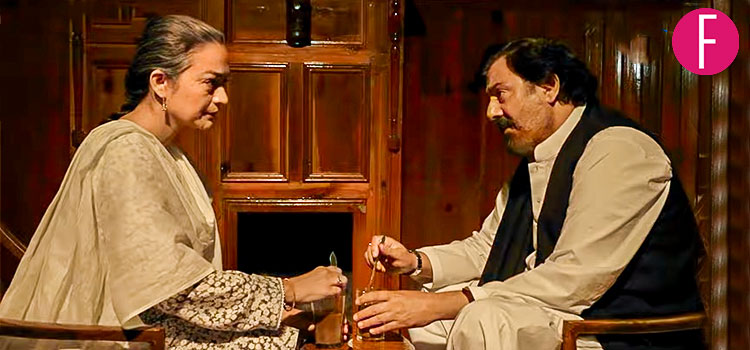
Zarsangha & Marjan Khan’s story ended in tragedy as they planned their end, away from the eyes of all their loved ones, united in life and united in death too.
On the one hand, the mind tells us suicide is not acceptable as a course of action, it is irresponsible to portray this plot twist especially when it comes from those who were shown to be strong-minded, steadfast characters who fought for the good and rose against evil.
On the other hand however, …
The makers had mentioned that Sang E Mah is inspired from the classic Shakespearean tragedy Hamlet. Now the idea (I assume), was never to copy paste the drama word for word, scene by scene but yes, inspirations came from the portrayal of Hilmand aka Atif Aslam’s character as the overthinking, over calculating hero ( who should have died rightly, according to Shakespeare) but lived on to save the day – very Pakistani that!
Should the other central characters – Marjaan and Zarsangha, staying true to Shakespeare’s Hamlet have died, but not by way of suicide? Pakistani dramas, after all, serve the dual purpose of not only providing entertainment but also handing out social messages to households across the nation – suicide might not be a message we want to propagate?
But then, argue others, where is the creative license of the makers? When can they depict an art form purely for the purpose of satisfying their creative mood, to depict a scene steeped in tragedy yet, show such an intensely close bond between two human beings that it transcends all worldly judgements:
“Itne lambe safar pe akeli kaise jaogi, dar nahi lage ga tumhe” … Marjan Khan to Zarsangha, on her impending journey towards Allah.
I bet with all my head and heart, that these lines resonated with many couples who grow old together, longing to be united in death just as in life, and fearing that one will leave the other too soon. It is perhaps, the only time they wish their beloved might pass away sooner than them because, they wouldn’t want them to deal with the pain or loss of a loved one, but then, they also fear the thought of making them suffer death on their own and want to hold their hand all the way, right into the next world!
Oh, My Heart! Sang E Mah you just made so many couples speak out loud in their heads.
But then there’s the other thing from Mr. Shakespeare that tears at my thoughts too. Why pronounce your own judgement before Allah has had a chance to pronounce His. When Zarsangha tells Marjan, we might be saved here, but what of the final court of law above – the pain of living with the guilt of taking a life, no matter how unworthy, is tearing at her now. She hasn’t forgiven herself, and fears Allah won’t either. Had she continued living, could she have lived with that guilt forever? Did she believe this was her punishment?
Flawed Reasoning?
Flawed reasoning? Yes! Especially since justice was served to them in the jirga – only, it was too late – they weren’t aware of this favourable outcome. Tragic? Yes. Unjustly Shakespearean? Yes!
Because you see, Shakespeare says my characters will die and they will be flawed and they will not receive justice!
And here I rest my case.
Marjan Khan and Zarsangha’s end was what a tragedy is made of. It was tragic because it did not need to happen, it was flawed because the characters‘ logic on why they needed to die was incorrect. (And that, by the way, one can argue, is the reason why suicide seemed such a worthless way out, and the drama proved that ironically, by showing it through Marjan & Zarsangha). In other words, suicide depicted in a certain context might help show viewers that it is really not a good thing after all!
But the joint suicide was also deeply moving because we human beings who inhabit relationships similar or nearly similar to Marjan and Zarsangha, felt that tragedy vicariously. We breathed their bond and often, heard it like a fleeting whisper in our lives, knowing fully well that it is not what we would do with our lives, ending them in this manner. but they (Marjan and Zarsangha) can, because they are two overtly flawed, overtly dramatic characters in a dramatic story that gripped us for the sheer beauty of its revelations and relationships. They loved with a passion but they also erred with the same. Their judgements, actions and predictions in life led them to take an action which was as flawed as their lives. Being strong, lovable characters did not mean they were always right.
Had Sang E Mah makers not acknowledged that the drama was inspired by a Shakespearean tragedy, I would not have granted them that creative license – of depicting not one, but two suicides onscreen in a drama screened to millions across the nation.
Are they still being irresponsible in a country like Pakistan? Can other dramas show the same narrative and can we argue that it is their creative freedom too?
No.
Because Sang E Mah is a drama that created a make-believe world from scratch. It gave us characters that spoke in poetic rhythm like Hilmand or lived alone in a hugely patriarchal society like Zarghuna. But that in no way takes away from some critical real-life lessons handed out by Sheherzade aka Kubra’s character, on overcoming abuse and finding love, from Gul Meena, Zarsangha, and Zarghuna’s characters, for being the strong women they were, from Awwal Khan’s character for walking a fulfilling journey, from Mastaan Singh’s character, for promoting interfaith harmony.
From creating awareness on a practice that needs to be shunned forever and ever – Ghag.
So, to wrap it up. Should a Pakistani drama portray suicide as an option for any character at all? No, if it is any odd drama depicting real life characters and relationships.
But … if it is Sang E Mah, it might just get away with it … or has it already?
Poetry in motion is sometimes hard to comprehend unless you tie it to a classic storyteller like William Shakespeare. And then, my dear folks … you might even get away with murder, and I think they just did! What do you think?

